

/cloudfront-us-east-2.images.arcpublishing.com/reuters/JEUL2B5V7BJCFMRTKGOS3ZSN4Y.jpg "Hungary’s anti-LGBTQ law breaches international rights standards – European rights body")


/cloudfront-us-east-2.images.arcpublishing.com/reuters/DYF5BFEE4JNPJLNCVUO65UKU6U.jpg "The curious case of a map and a disappearing Taiwan minister at U.S. democracy summit")

/cloudfront-us-east-2.images.arcpublishing.com/reuters/UF7R3GWJGNMQBMFSDN7PJNRJ5Y.jpg "Blinken touts deeper U.S. engagement amid concern over ‘aggressive’ China")







SYDNEY – Win Htet Oo has dreamed of participating in the Olympic Games since he was six.
But when the men’s 50-meter freestyle final took place in Tokyo on Saturday, the 27-year-old swimmer from Myanmar watched at home.
Despite his recent Olympic qualifying time and a national record, he is boycotting the Games in protest against the military coup that toppled his country’s elected government six months ago.
“It’s been two decades in development, slowly training, slowly improving, trying to be at the level I can represent my country at,” he told NBC News from his home in Australia earlier this week.
But then everything changed in the swimmer’s homeland when the military took power in February.
“I knew immediately – I couldn’t represent Myanmar – not while the military was in charge,” he said.
Instead, he hopes to draw the world’s attention to the country and put pressure on what he calls the “hypocritical” International Olympic Committee.
From hope to despair
Win Htet Oo was born in Malaysia to parents from Myanmar. After attending college in New York, he moved to Melbourne where he focused on his swimming.
But it was a visit to Myanmar in 2016 that made him double his Olympic dream.
After more than 50 years of brutal military rule, the 2015 parliamentary elections brought Nobel Peace Prize laureate Aung San Suu Kyi and her party to power in what was seen as an important step on the country’s difficult path to democracy.
“I’ve seen a lot of hope. I saw a lot of energy and courage, especially in the creative arts … It really inspired me to think about what I do as a swimmer, as an athlete, ”he recalls.
Download the NBC News App for the latest news and politics
The stars appeared to be aligning for Tokyo 2020, with Win Htet Oo competing at the 2019 Southeast Asian Games, securing both an Olympic qualifying time and a national record in the 50-meter freestyle.
Then came the military coup.
“There was disbelief … I had so much hope that the transition to democracy would succeed, no matter how slow the pace,” said Win Htet Oo.
Win Htet Oo now works as a pool lifeguard where he trains in Melbourne, Australia.Sandra Sanders / Reuters
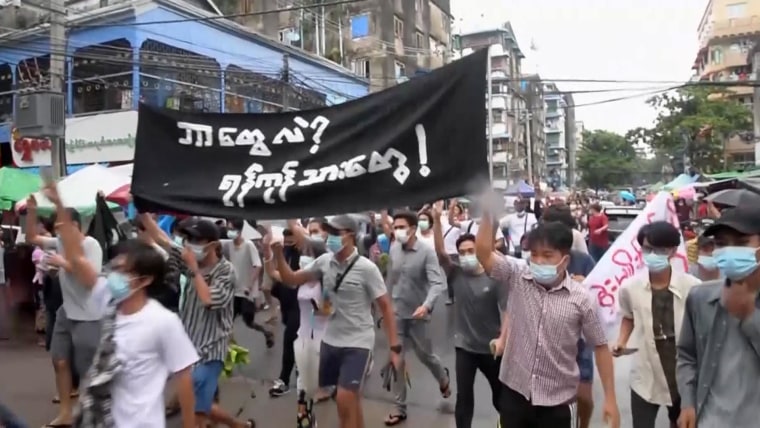
Concerning human rights groups, the military has violently suppressed protests across the country in an attempt to consolidate power.
More than 900 people who opposed the junta were killed by security forces, leading to international convictions and sanctions, including from the United States.
“Six months since the coup, the military junta has arbitrarily arrested thousands, killed hundreds of civilians, including dozens of children, and now people face a deadly pandemic on their own,” said Manny Maung, a Myanmar researcher with Human Rights Watch.
“This shows us how completely unprepared and unable to rule the military … The economy has collapsed, the health system has collapsed, and aid is not reaching the most vulnerable.”
IOC request denied
After the coup, the military also took control of the Myanmar Olympic Committee – another reason Win Htet Oo said he could not compete on the national team.
He wrote to the International Olympic Committee asking if he could come to Tokyo as an independent athlete. But the organization denied his request.
Having “no other options,” he withdrew from the exam before the Myanmar team was completed.
“People need to know that the Myanmar military is not just another military who has taken power in a backward developing country,” he said.
Related
“People think fascism is long dead after World War II, but no, it exists in Myanmar today and it’s shocking that the world continues to tolerate it.”
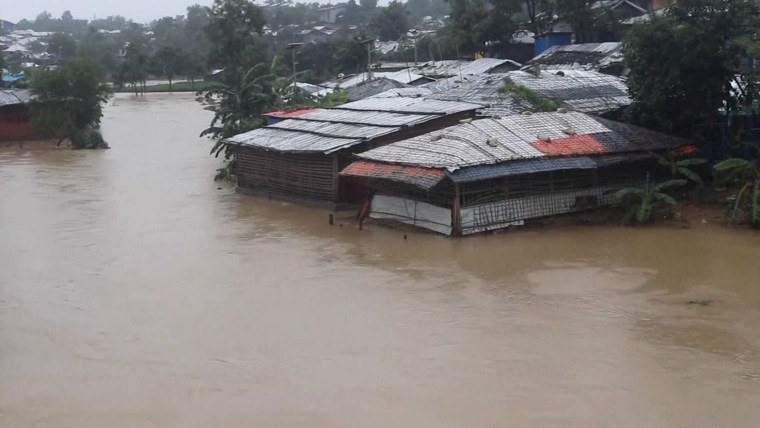
“This is a military charged with the genocide of the Rohingya and other ethnic peoples in Myanmar,” he added, citing a deadly crackdown on the Rohingya minority population in Rakhine state of over 1 million people who fled in 2017.
In a statement, the IOC said the Myanmar Olympic Committee remains “the IOC officially recognized National Olympic Committee (NOC).”
“In the past few months, the NOC has repeatedly reaffirmed its focus on preparing its team for the Tokyo 2020 Olympic Games,” it said. “In accordance with the Olympic Charter, all qualified / eligible athletes should be reported by their respective IOC-recognized NOCs.”
While the Myanmar Olympic Committee sent a team of seven to the last Olympic Games in Rio de Janeiro, this time only two will compete.
“It’s hypocritical”
Win Htet Oo said he was deeply concerned about the IOC’s response to his request and is now calling for the organization’s recognition of national Olympic committees to be reformed.
“You are sticking to political neutrality, even though I think the Myanmar Olympic Committee is against the Olympic Charter.”
“It’s hypocritical,” he said of the Olympic Games’ avowed ambition to promote peace and harmony.
But experts say this is nothing new.
“What the IOC is interested in is the financial result and a good show,” said Dr. Tom Heenan, who teaches sports science at Monash University in Melbourne.
“The Olympic Charter has noble words … But that’s all just eyewash. The main goal of the Olympics is to generate revenue for the IOC and the Olympic Movement, ”he said.
(NBCUniversal, parent company of NBC News, paid $ 7.5 billion to extend its media rights to the US Olympics through 2032. NBCUniversal is the International Olympic Committee’s largest source of income.)
Myanmar has been in chaos since the military coup, with regular protests and fighting between the army and newly formed militias.Ye Aung Thu / AFP via Getty Images File
Heenan said it was “part of the history of the IOC and the Olympic movement” to turn a blind eye to human rights abuses, the most egregious example being the 1936 Berlin Olympics.
The IOC has repeatedly said that it has to be “neutral” and stay out of politics, although its President Thomas Bach insisted earlier this year that it was “not a super-world government”.
In recent years, it has increasingly focused on human rights, with the rights requirements being included in the venue contract for the next Summer Games in Paris in 2024.
But next year’s Winter Games, which will take place in Beijing, have also been criticized in view of the growing international backlash against China’s treatment of the Uyghur minority Hong Kong and Tibet.
China denies wrongdoing and its foreign ministry criticized “the politicization of sport” saying that any boycott is “doomed to fail”.
Meanwhile, Win Htet Oo has to watch the finale, where he dreamed of another continent because he knew he could have been there.
“[But] I have hope, ”he said. “Let’s think about how sport can be a force to protect basic human rights. This is the next big idea that the IOC and the athletes really need to think about. “
“Many athletes around the world want to see the sport as a real force for good, not just empty words,” he added. “Let’s use sport as a real vehicle for a more ethical, humane world.”