


/cloudfront-us-east-2.images.arcpublishing.com/reuters/JEUL2B5V7BJCFMRTKGOS3ZSN4Y.jpg "Hungary’s anti-LGBTQ law breaches international rights standards – European rights body")


/cloudfront-us-east-2.images.arcpublishing.com/reuters/DYF5BFEE4JNPJLNCVUO65UKU6U.jpg "The curious case of a map and a disappearing Taiwan minister at U.S. democracy summit")

/cloudfront-us-east-2.images.arcpublishing.com/reuters/UF7R3GWJGNMQBMFSDN7PJNRJ5Y.jpg "Blinken touts deeper U.S. engagement amid concern over ‘aggressive’ China")





MOSCOW – Russia is in the midst of the greatest crackdown on the free press and political dissent since Soviet times.
The driving trends are numerous and have been in use for years. But in the past 18 months state pressure on independent journalism has increased tremendously.
Instead of overt brutality, this latest campaign is being conducted in silence with a vague legal instrument: a law that regulates the activities of so-called foreign agents.
It was first used against a media company in 2017 when several US government-funded media outlets such as Voice of America were declared foreign agents. But last year the state began using them against independent Russian journalists.
“It’s not about getting money from abroad,” said Sonya Groisman, 27, a reporter who was added to the list of foreign agents after her Proekt outlet was closed after being labeled “undesirable.”
“It is a law to silence all independent voices,” she said.
The first targets of this attack on independent, critical journalism in Russia were legal entities, i.e. entire editorial offices. But recently, the state has also been wearing individual journalists with the label. Groisman was one of them. And the list is public and often serves as the first notification people receive from authorities to let them know of their new reality.
The challenges facing Russian journalists were recognized by the Norwegian Nobel Committee on October 8, when Dmitry Muratov – an editor at the independent news agency Novaya Gazeta – jointly awarded this year’s Peace Prize for his “efforts to uphold freedom of expression” in the country.
Muratov dedicated the award to his “deceased colleagues,” a direct reference to the price independent journalists in Russia have paid for their work over the years. The Novaya Gazeta in particular has taken a heavy toll. Muratov received the award the day after the 15th anniversary of the murder of her most famous reporter, Anna Politkovskaya.
The Kremlin press office told NBC News that those identified as foreign agents are not legally restricted from journalism and that they have the right to appeal the designation in court.
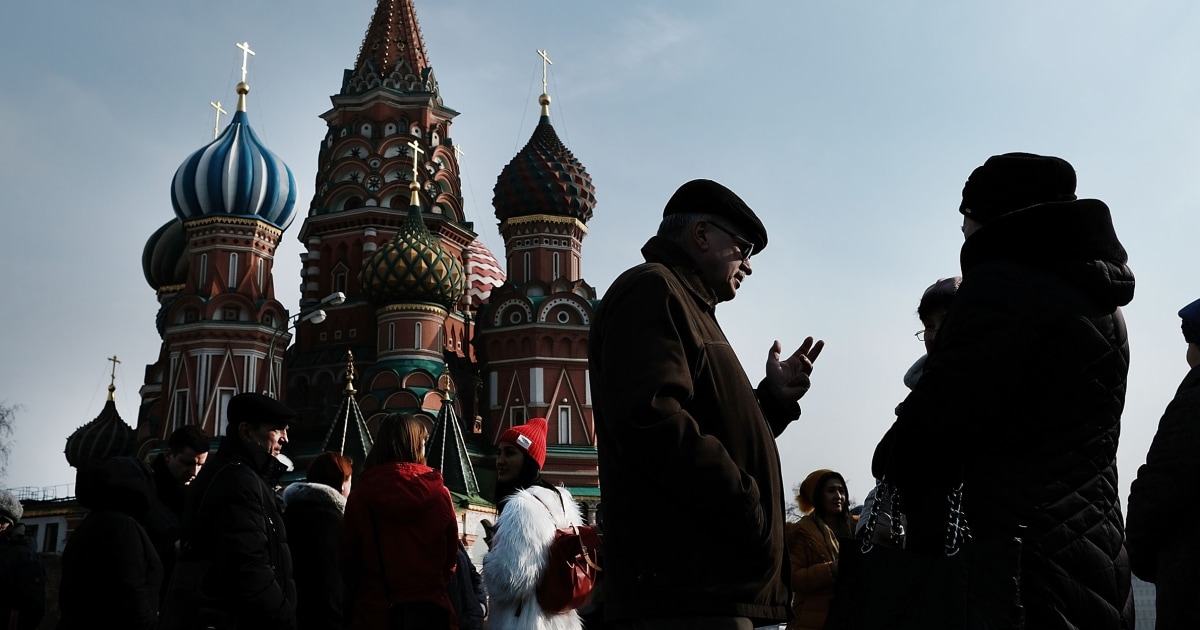
The Kremlin’s moves to address domestic disagreements have raised fears of a return to communist-era freedom of expressionSpencer Platt / Getty Images
The Foreign Agents Act was signed in 2012. Before its first use against the media in 2017, the state used it against NGOs and civil society groups – often those focusing on human rights – that had received foreign grants.
“I don’t think there has ever been a worse time for Russian civil society and the media in general,” said Alexey Kovalev, editor of the independent news site Meduza. “And I think we haven’t even hit rock bottom because this machine doesn’t really have a reverse gear. It’s actually getting worse and worse. “
The way it works is simple: every Friday the Justice Department updates a public list of “foreign agents” posted on its website. There are currently around 90 organizations and individuals on the list. The list has nearly doubled in size in the last month, with almost every major independent retail outlet now represented.
“The authorities have become smart and demanding,” said Gulnoza Said, director for Europe and Central Asia at the Committee for the Protection of Journalists. “They don’t use the targeted killing of journalists like they did 20 years ago. They use laws to legitimize the crackdown. “
By designating a journalist or media company as a foreign agent, the state is placing two significant legal burdens on them: the first is a statutory disclaimer that must accompany everything they publish online; the second is a quarterly report on all of their financial activities. Any misstep could result in criminal prosecution and / or fines.
“It is not the Russian state that is driving you out of business, you have to destroy your own business yourself,” said Kovalev. “You need to hire a lawyer to handle the paperwork, an accountant to handle the financial records. And now that individuals have been declared foreign agents, you can see how devastating it really is. “
President Vladimir Putin spoke about the law at a forum in Moscow on Wednesday, defending the list of foreign agents as a routine act of bureaucracy, similar to the Foreign Agent Registration Act in the United States. This law requires think tanks, lobbyists and foreign state-funded media to report financial ties to foreign governments, but is less aggressive than Russian law.
“This law was passed in the United States in the 1930s and is still in use today, including for Russian media,” Putin said. “Both there and in our country, this is done with one goal: to protect internal political processes from external influences. Foreign agents are not prohibited from political or professional activities, they just have to register. “
Moscow has long tried to fend off allegations of repression of dissent by claiming that it is no different from the United States.Spencer Platt / Getty Images
Said of the CPJ said when the US applied its FARA law in 2017 against the state-funded Russian media outlets Russia Today and Sputnik, the organization warned against it, arguing that the Russian government would initiate a tit-for-tat response from the Russian authorities. That happened to Voice of America in Russia, he said.
The CPJ also warned that Russia would go a step further and use its version of FARA against independent media outlets. That happened too, he said.
Russian journalists who come across the label at home point out that there is no trial and no burden of proof on the state that any organization or person enrolled in the foreign agent register has ever received money from abroad.
For those on the list, it feels permanent.
“The only times someone has got off the list are organizations that have self-destructed, but I cannot self-destruct,” said Groisman. “So there are only two options. The first option is to have some officials ask the Justice Department to remove you from the list.”
“The second option is my death,” she said. “Maybe that’s more realistic.”