


/cloudfront-us-east-2.images.arcpublishing.com/reuters/JEUL2B5V7BJCFMRTKGOS3ZSN4Y.jpg "Hungary’s anti-LGBTQ law breaches international rights standards – European rights body")


/cloudfront-us-east-2.images.arcpublishing.com/reuters/DYF5BFEE4JNPJLNCVUO65UKU6U.jpg "The curious case of a map and a disappearing Taiwan minister at U.S. democracy summit")

/cloudfront-us-east-2.images.arcpublishing.com/reuters/UF7R3GWJGNMQBMFSDN7PJNRJ5Y.jpg "Blinken touts deeper U.S. engagement amid concern over ‘aggressive’ China")






Philippine Defense Minister Delfin Lorenzana has promised that Manila will ignore China’s amended maritime law, which now requires foreign ships sailing in the South China Sea to report their information to the Chinese authorities.
“Our position on this is that we are not obeying these Chinese laws in the West Philippine Sea because we believe that we have the sovereign right in these waters. So we will not recognize this Chinese law, ”said Lorenzana during an event on the Mutual Defense Treaty (MDT) between the Philippines and the United States.
Lorenzana made the statement as he continued his visit to the United States to press for a review of the MDT and to advocate more advanced military equipment for the Philippines in the face of the territorial threat posed by China.
China, which claims historic rights to most areas in the South China Sea, has changed its maritime safety law in recent months. It came into force on September 1st.
The law requires all foreign vessels sailing in the South China Sea to report their information to the Chinese authorities.
A 2016 ruling in The Hague said China’s claim to most of the South China Sea has no legal basis, but Beijing ignored the decision and continued to expand its presence in the region, building artificial islands with runways and docks which sparked further tension with neighboring countries.
Several Southeast Asian countries, including the Philippines, have overlapping claims with China in the South China Sea.
On Monday, the Chinese state publication Global Times reported that the revised maritime law came into effect on September 1st.
It includes five types of ships, including submersibles, nuclear ships, ships with radioactive material, ships with bulk oil, chemicals, liquefied petroleum gas and other toxic and noxious substances, as well as other ships “that could endanger China’s maritime safety,” according to the Global Mal.
Beijing made it clear that the new law does not restrict freedom of navigation in the South China Sea.
But the US calls it a “serious threat,” and one foreign policy expert has described it as an attempt by China to force other countries to submit to its control by reporting their ships to the Chinese authorities.
In January, China also passed the Coast Guard Act, which for the first time specifically allows its coast guard to fire on foreign ships on its territory.
Update, update
Amid concerns over China’s growing dominance in the South China Sea, the Philippines, a long-time US ally, want Washington to expand its military obligations.
Lorenzana, the Philippine defense chief, said it was time for a full review of Manila’s alliance with the US.
He said it was necessary to “upgrade” and “update” the alliance and clarify the “extent of American commitments”.
“In Manila, some questions are asked: Do we still need the MDT? we should change it, “he told the Washington Center for Strategic and International Studies on Wednesday, referring to the 1951 pact.” What is clear is that we need a comprehensive review of our alliance. “
Lorenzana pointed out that the U.S. treaty with Japan, his enemy in World War II, was clearer than the one with Manila when it came to determining whether it applied in the Pacific Sea area, where the Philippines fell due to rival territories increasing pressure from China advised allegations.
He said this explains why seven out of ten Filipinos supported President Rodrigo Duterte’s call for engagement with China rather than confrontation, and more than half questioned the US’s reliability as an ally in disputes in the South China Sea.
Lorenzana said US-Philippines relations must develop “in recognition of the new geopolitical realities, particularly the rise of China.”
He said Manila and Washington should consider revising the MDT and other defense pacts to ensure that both could better respond to “gray area threats” such as state-sanctioned Chinese maritime militias intimidating smaller states.
Duterte had previously also blamed the United States for failing to enforce an agreement brokered between Beijing and Manila on the simultaneous withdrawal of naval forces from the controversial Scarborough Shoal, which was administered by the Philippines until 2012.
China took control of Scarborough Shoal after the Philippines withdrew from the area following a US promise. China and the Philippines were supposed to withdraw their troops from Scarborough Shoal, but Beijing failed to honor the deal and Washington failed to enforce it.
Reluctance in the USA
Manila has repeatedly protested the so-called “illegal” and “threatening” presence of hundreds of Chinese “maritime militia” ships in its Exclusive Economic Zone (EEZ), according to a 2016 ruling in The Hague.
Hundreds of Chinese ships have been sighted in the Philippine EEZ multiple times this year, sparking an angry response from Manila. But Duterte had also said the Philippines could not afford to oppose Beijing militarily.
In his statement from Washington, DC, Lorenzana Dutertes repeated complaints about the reluctance of the US to supply the Philippines with state-of-the-art weapons.
He said Manila is in the middle of an unprecedented military modernization program and needs to go beyond the Vietnam War-era hardware that Washington provided in the past.
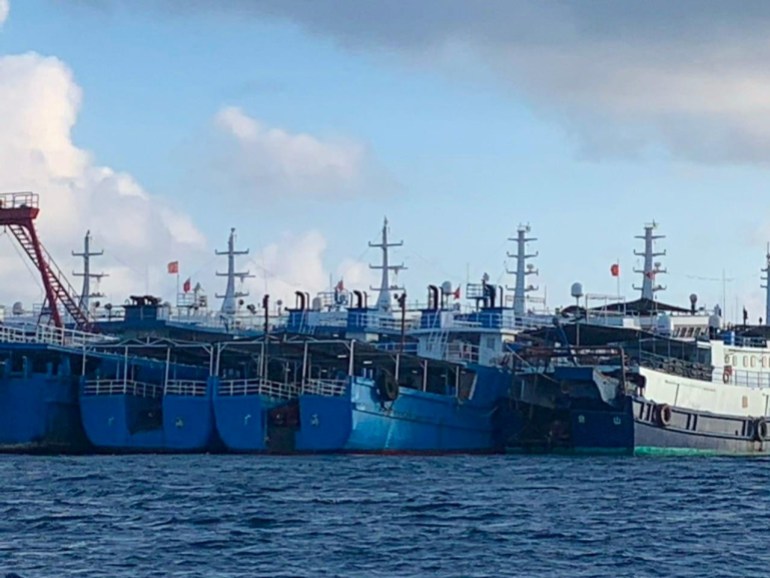 Manila has repeatedly protested the “illegal” and “threatening” presence of hundreds of Chinese “maritime militia” ships in its exclusive economic zone, according to a 2016 ruling in The Hague [File: Philippine Coast Guard via Reuters]
“Non-treaty allies … have received billions in military aid and advanced weapons systems from the US. Perhaps a longtime ally like the Philippines facing great adversaries in Asia deserves just as much, if not more, help and commitment, ”he said.
Lorenzana’s remarks came after Duterte reestablished the Visiting Forces Agreement (VFA) in July, which governs the movement of U.S. troops in and out of the country, something strategically crucial in American efforts to combat China. While there are no US bases left in the Philippines, the two countries hold annual military exercises until Duterte issued his threat to end the pact last year.
Duterte had promised to end the VFA after Washington refused a visa to a Filipino senator who is an ally of the president.
For Washington, the ability to rotate troops through the VFA is important not only in defending the Philippines, but also strategically when it comes to fighting China in the region.
In July, US Secretary of State Antony Blinken reiterated a warning to China that an attack on Philippine forces in the South China Sea would trigger the mutual defense treaty.