



/cloudfront-us-east-2.images.arcpublishing.com/reuters/JEUL2B5V7BJCFMRTKGOS3ZSN4Y.jpg "Hungary’s anti-LGBTQ law breaches international rights standards – European rights body")


/cloudfront-us-east-2.images.arcpublishing.com/reuters/DYF5BFEE4JNPJLNCVUO65UKU6U.jpg "The curious case of a map and a disappearing Taiwan minister at U.S. democracy summit")

/cloudfront-us-east-2.images.arcpublishing.com/reuters/UF7R3GWJGNMQBMFSDN7PJNRJ5Y.jpg "Blinken touts deeper U.S. engagement amid concern over ‘aggressive’ China")








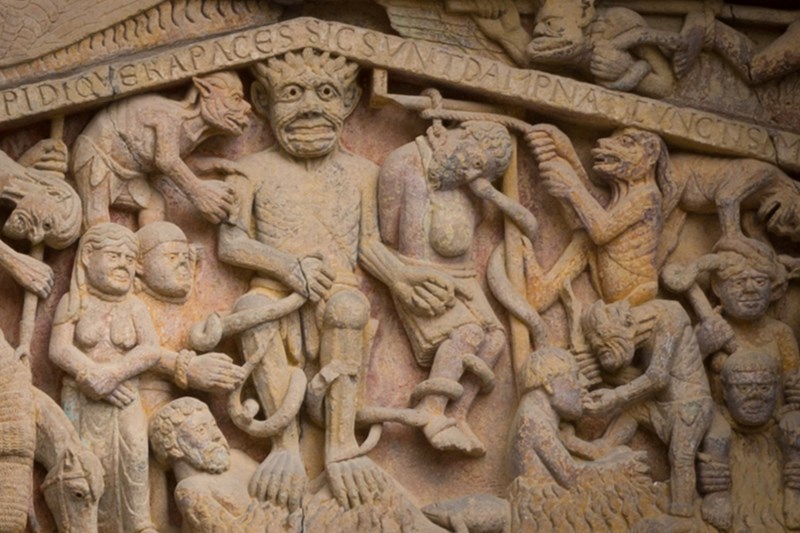
Photo by Russell Cothren
In this detail from the tympanum of the abbey church of Sainte-Foy in Conques, France, a usurer can be seen to the left of the devil, hanging from his wallet.
According to the PEW Research Center, the wealth gap between America’s richest and poorest families more than doubled from 1989 to 2016.
This accumulation of wealth in the hands of a few is an ongoing problem that has sparked civil unrest, and it will be part of the focus of a public talk offered by the U of A Honors College next week.
Sharon Foster, Sidney Parker Davis Jr. Professor of Law, will lead the discussion titled “Economic Thought and Competition Law,” which examines these issues in ancient times and in the Middle Ages.
The public lecture will be on Wednesday, September 22nd. at 5:15 p.m. online via Zoom. Please fill out this online interest form to gain access to the lecture.
“We have an asset concentration problem,” said Foster. “It creates economic instability; it causes political instability and civil unrest. Do we see that now? What can we learn from the past, what to look for, and what to do to correct some of these instabilities? Competition law has provided a lot of knowledge on many of these questions. “
Foster’s talk previewed the Honors College Signature Seminar, Economic Thought and Competition Law in Spring 2022.
BIRTH OF THE MONOPOLY
Economic thinking is the study of what economists thought was happening, what happened, or would happen in a particular economy.
Although there is no story in the historical record of an actual cartel or monopoly in ancient Mesopotamia, the reforms of Urkagina, king of the city-states of Lagash and Girsu in Mesopotamia, around 2400 BCE, mention concerns that are reflected in modern antitrust law .
Similarly, other legal codes from ancient Mesopotamia deal with economic justice with a view to preventing high monopoly prices. In the Bible, Genesis 37: 1-11 sets the story of Joseph’s interpretation of Pharaoh’s dream, which some have described as a story of a grain monopoly.
The study of ancient and medieval economic thought provides a thorough understanding of the origins of competition law, or as it is known in the United States, antitrust law.
Despite numerous historical records on competition law, there are very few historical analyzes of competition law from antiquity or the Middle Ages.
“It’s an extremely long period,” said Foster, “but it’s a period that really hasn’t received much attention from scientists.”
In Foster’s Signature Seminar, students analyze economic thinking starting with the ancient city-states of Mesopotamia from about 2402 BC
Emphasis will be placed on economic thinking related to cartels and monopoly as expressed in ancient codes, biblical sources, canon law, philosophical writings and literature. Using these sources from antiquity and the Middle Ages, this signature seminar will illustrate the connection between early economic thinking and modern economic theory in its application to competition law.
“I see the parallels with the concentration of wealth in the hands of a few as economic instability and ultimately political instability,” said Foster. “Especially after the financial crisis of 2008 we saw that many people were economically displaced. They lost their homes, they lost their jobs, they no longer had to go to school. And we have seen a wider gap between the rich and the poor in some countries. And we have also seen the middle class shrink, where people were doing well economically. “
With the start of the pandemic in 2020, conditions deteriorated due to labor shortages.
However, there were some signs of economic recovery – including higher wages and a growing middle class.
“Having a strong and resilient middle class means that the economy will actually be healthier longer in the long run because we have more people working, buying things and contributing to GDP,” said Foster.
Sharon Foster joined the Faculty of Law in 2000 and became a Tenure Track Assistant Professor in Fall 2006. Prior to her arrival, she was Associate Professor at Loyola Law School in Los Angeles from 1998 to 2000. She has taught in the Legal Research & Writing Program and has offered courses in international legal research and international finance. She has also coached the Jessup International Law Moot Court team.
Foster received her BA from the University of California at Los Angeles in 1983, her JD from Loyola Law School in 1987, her LL.M. 1997 from the University of Edinburgh and a Ph.D. in Law in 2007 from the University of Edinburgh, Scotland. From 1987 to 2000 she worked in Los Angeles in her own practice with a focus on construction and international law. Her most recent publications have been in the field of antitrust and international law.
SIGNATURE SEMINARS EXPLORE A WIDE RANGE OF TOPICS
Economic Thought and Competition Law is one of two Honors College signature seminars scheduled for spring 2022.
The other seminar is Euclid, taught by math professor Edmund Harriss and rare book librarian Joshua Young.
Deans of each college can nominate professors to attend this program, and those selected to teach become Dean’s Fellows in the Honors College.
Honors students must apply to participate, and those selected are referred to as Dean’s Signature Scholars. The course registration will be published online on the Signature Seminars website. The application deadline is Monday, October 25th.
About the Honors College: Founded in 2002, the University of Arkansas Honors College brings together high-performing students and the university’s top professors to share transformative learning experiences. Each year, Honors College awards up to 90 freshmen scholarships that provide $ 72,000 over four years, and more than $ 1 million in freshman research and study abroad scholarships. Honors College is recognized nationwide for the high quality of the students and graduates it admitted. Honors students enjoy small, in-depth courses, and programs are offered in all disciplines tailored to the students’ academic interests, while encouraging interdisciplinary collaboration. Fifty percent of Honors College graduates have studied abroad and 100 percent of them have done mentoring research.
About the University of Arkansas: As a flagship institution in Arkansas, the U of A offers internationally competitive education in more than 200 academic programs. Founded in 1871, the U of A contributes more than $ 2.2 billion to the Arkansas economy by providing new knowledge and skills, entrepreneurship and job development, discovery through research and creative activities, and training in professional disciplines. The Carnegie Foundation places the U of A in the top 3% of US colleges and universities with the highest research activity. US News & World Report ranks the U of A among the best public universities in the country. See how the U of A works to create a better world on Arkansas Research News.