


/cloudfront-us-east-2.images.arcpublishing.com/reuters/JEUL2B5V7BJCFMRTKGOS3ZSN4Y.jpg "Hungary’s anti-LGBTQ law breaches international rights standards – European rights body")


/cloudfront-us-east-2.images.arcpublishing.com/reuters/DYF5BFEE4JNPJLNCVUO65UKU6U.jpg "The curious case of a map and a disappearing Taiwan minister at U.S. democracy summit")

/cloudfront-us-east-2.images.arcpublishing.com/reuters/UF7R3GWJGNMQBMFSDN7PJNRJ5Y.jpg "Blinken touts deeper U.S. engagement amid concern over ‘aggressive’ China")








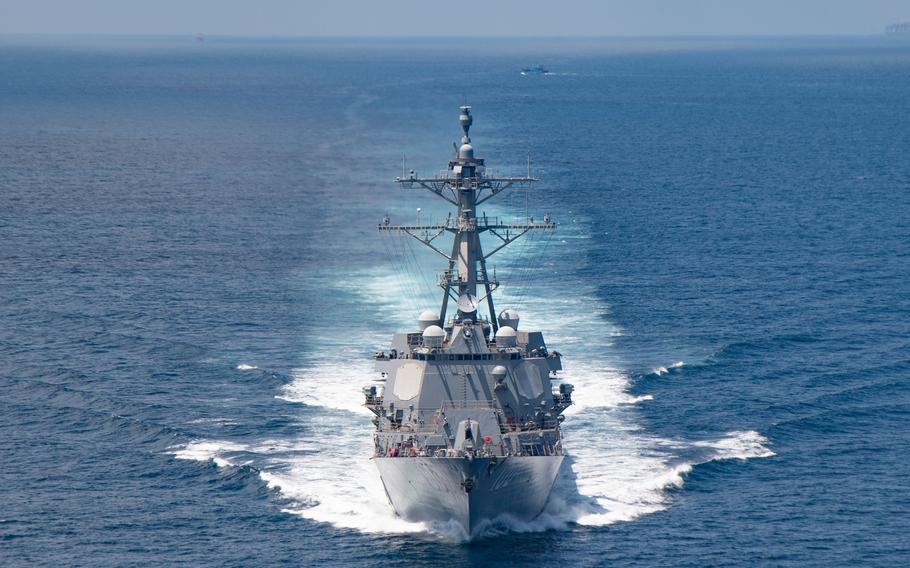
The guided missile destroyer USS Kidd steams across the Taiwan Strait on August 27, 2021. (Kaylianna Genier / US Navy)
The US Navy’s operations in the South China Sea will not be affected by a new Chinese law requiring foreign ships to report before entering waters claimed by Beijing, according to the Defense Department.
An amendment to China’s 1983 Maritime Safety Act, which went into effect Wednesday, requires certain ships to provide a checklist of information, including call signs, locations, estimated time of arrival and the nearest port of call, the state-run Chinese Global Times reported on Sunday.
The change stipulates that submersibles, nuclear-powered ships, and ships carrying hazardous substances like oil or chemicals must notify Chinese officials before entering areas China designates as territorial waters, according to the Naval War College’s Stockton Center for International Law.
The change was approved by the Standing Committee of the National People’s Congress of China in April.
However, under international law, U.S. forces will continue to cross or operate in these areas, according to a Department of Defense spokesman.
“The United States will continue to fly, sail and operate wherever international law allows,” Lt. Col. Martin Meiners said in an email to Stars and Stripes on Wednesday.
The Navy’s 7th Fleet routinely conducts freedom of navigation and transit operations through areas that China has claimed as its territorial waters, including the cross-strait and island chains in the South China Sea.
The guided missile destroyer USS Kidd last steamed across the Taiwan Strait on August 27, the Navy’s eighth voyage this year.
The US has long claimed that a nation’s law “must not violate the rights of other nations under international law,” Pentagon spokesman John Supple told Stars and Stripes on Wednesday in an email.
“Illegal and far-reaching claims at sea, including in the South China Sea, pose a serious threat to the freedom of the seas, including freedom of navigation and overflight, free trade and unhindered lawful trade, and the rights and interests of the South China Sea and other coastal nations, ”he said.
Beijing regularly criticizes US Navy activities in areas it claims in the South China Sea, along with the US position in denying these claims.
“China’s sovereignty, rights and interests in the South China Sea have developed over the course of a long history,” Zhao Lijian, a spokesman for the Chinese Foreign Ministry, said at a press conference on July 12th. “They are backed by a rich historical and legal foundation and have been supported by the Chinese government all along.”
No country objected to this position until the 1970s, Zhao added.
“The US charge that our maritime rights and interests in the South China Sea have no legal basis is completely contrary to the facts,” he said.
Beijing’s alleged claim to large parts of the South China Sea stems in large part from the “nine-dash line,” a delineation that was copied from a 1947 Chinese map. In 2016, a United Nations tribunal declared some of China’s claims in the South China Sea to be illegal under the Convention on the Law of the Sea.
Alex Wilson


Subscribe to Stars and Stripes
Only 99c per week!
Subscribe to